01
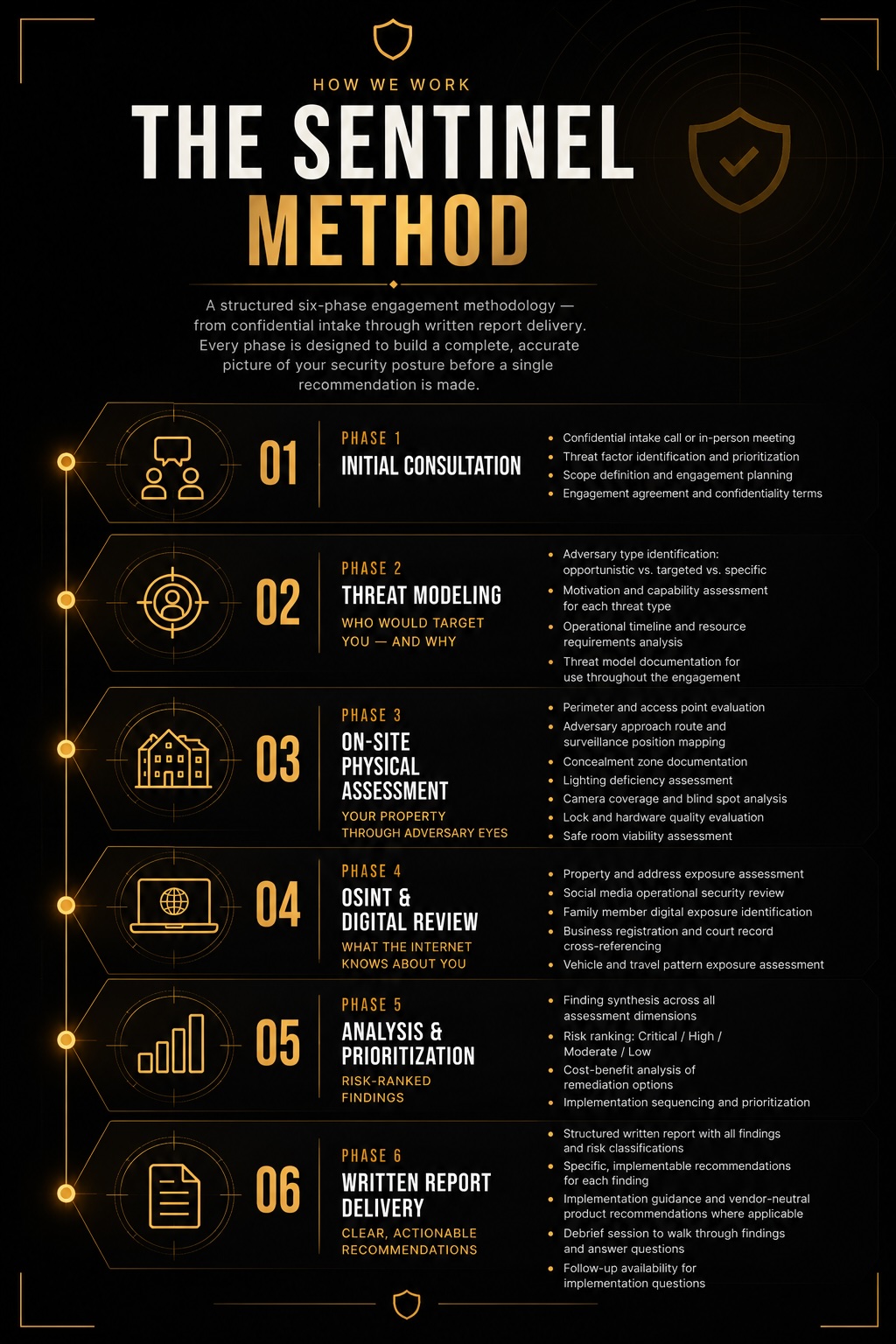
Phase 1 · Initial Consultation
Confidential Intake
Every engagement begins with a confidential consultation to understand your situation, concerns, and objectives. We discuss your property, family structure, professional profile, and known or suspected threat factors.
- Confidential intake call or in-person meeting
- Threat factor identification and prioritization
- Scope definition and engagement planning
- Engagement agreement and confidentiality terms
02
Phase 2 · Threat Modeling
Who Would Target You — and Why
Before we set foot on your property, we build a threat model defining realistic adversary types relevant to your profile — opportunistic, targeted, or specific — and the information each would need to act against you.
- Adversary type identification
- Motivation and capability assessment
- Operational timeline and resource requirements analysis
- Threat model documentation
03
Phase 3 · On-Site Physical Assessment
Your Property Through Adversary Eyes
We approach, observe, and document your property the way a motivated threat actor would, identifying surveillance positions, approach routes, concealment zones, entry vulnerabilities, lighting deficiencies, and response gaps.
- Perimeter and access-point evaluation
- Adversary approach route and surveillance mapping
- Concealment-zone and lighting deficiency documentation
- Camera blind-spot, hardware, and safe-room review
04
Phase 4 · OSINT & Digital Review
What the Internet Knows About You
We conduct a structured open-source intelligence sweep to determine what a motivated individual can discover about you, your family, and your property from public information.
- Property and address exposure assessment
- Social-media operational-security review
- Family member digital exposure identification
- Business and public-record cross-referencing
05
Phase 5 · Analysis & Prioritization
Risk-Ranked Findings
Findings from the physical assessment, threat model, and digital review are synthesized and ranked by risk, distinguishing immediate vulnerabilities from lower-priority improvements.
- Finding synthesis across all dimensions
- Risk ranking: Critical / High / Moderate / Low
- Cost-benefit analysis of remediation options
- Implementation sequencing and prioritization
06
Phase 6 · Written Report Delivery
Clear, Actionable Recommendations
Every Sentinel engagement concludes with a structured written report documenting findings, risk classifications, and implementable recommendations. We debrief the report with you so each next step is understood.
- Structured written report with all findings
- Specific implementable recommendations
- Vendor-neutral guidance where applicable
- Debrief session and implementation follow-up